
Which San Diego Resident Record Answers
A San Diego resident lookup is a set of focused record searches. Start with the fact that is known and choose the source that can actually confirm it. The table distinguishes an owner from a resident, a court party from a disposition, and an informational vital copy from an authorized certified copy. That distinction prevents a weak name match from becoming a false identity claim.
| Record | What It Confirms | Where to Search | Access |
|---|---|---|---|
| Assessor parcel | Assessed owner, situs, APN, mailing destination | County Parcel Lookup or ARCC | Address or APN route; owner is not necessarily resident |
| Recorded document | Grantor, grantee, date, type, legal description | ARCC Official Records | Free party index; image and copy routes separate |
| Superior Court index | Same-named party, case family, date, courthouse | San Diego Court Index | Free locator; file and disposition require next step |
| Voter registration | One voter’s status, precinct, and election information | Registrar self-check | Authenticated or approved file use only |
| Vital record | Birth, death, marriage, or family event | ARCC, County OVRS, CDPH | Informational and authorized-copy rules differ |
| License or business filing | Credential, entity, agent, or public address of record | DCA, SOS, ARCC FBN | Free search; affiliation is not residence |
If the clue is a current address, begin with parcel and deed evidence. If it is a case, begin with the Court Index. If it is a family event, use the vital or obituary route. If it is a public role, use a license, business entity, or fictitious business name. Look up a resident by purpose, not by collecting every unrelated record.
San Diego Resident Court Search
The San Diego Superior Court Party Name Search is the most precise local court entry point when a person’s name is known. It searches civil, criminal, domestic or family, mental-health, and probate categories. Narrow the search because the portal caps returned selections and common names can produce unrelated cases.
| Case Type | Required category such as Civil, Criminal, Domestic/Family, Mental Health, or Probate. |
|---|---|
| Case Location | Optional court division or location that narrows the search. |
| Party Type | Optional field applied to civil or domestic searches. |
| Beginning and ending year | Numeric filing-year range. |
| Last or business name | Required name-mode field; more characters can reduce capped results. |
| First name | Optional narrowing field. |
| Date of birth | Optional MM/DD/YYYY identifier. |
The result inventory is limited but useful: case title and parties, case number, file location, case type, and filing date. The index does not provide charges or disposition. A separate Register of Actions or official file must be examined before a case is described beyond its placement. Sealed, juvenile, adoption, family, and mental-health material can have additional restrictions.
The court-file access instructions screenshot below shows the next step after a name hit.
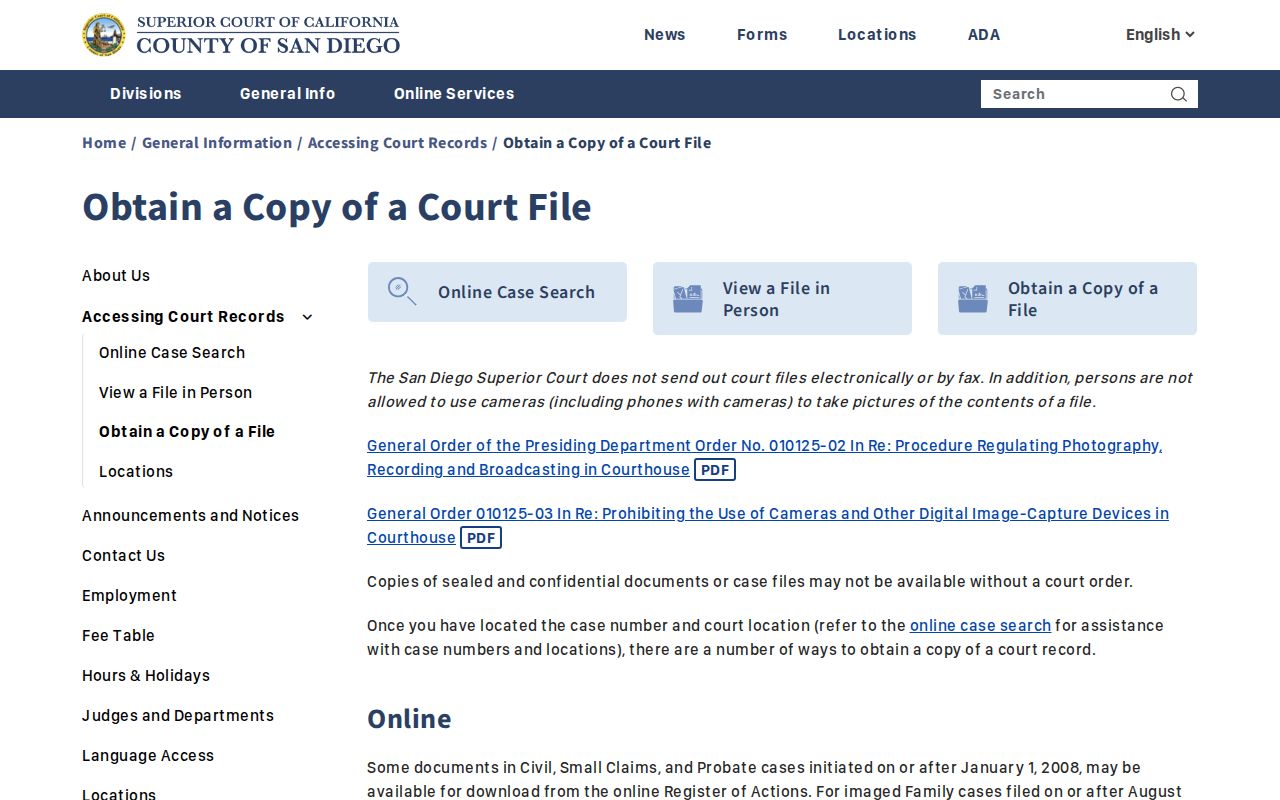
Inspection can occur through the appropriate courthouse counter or kiosk. Mail requests need a case number, party names, requested documents, contact information, an envelope, and payment. Copies are $0.50 per page, with possible search, retrieval, and certification fees. Some mail requests take several weeks and court files are not generally sent by fax or ordinary e-mail.
Verifying One San Diego Resident
Verification means matching independent identifiers, not finding the same name twice. Keep the exact spelling, middle initial, suffix, former surname, and source date. Compare geography through an APN, legal description, business city, court location, or known former address. Compare time through a directory year, deed date, license period, birth or death event, and case filing. The role also matters: grantee, petitioner, licensee, registered agent, owner, and occupant are not synonyms.
- Anchor the name to a known address or public role using the parcel route, DCA license, SOS entity, FBN filing, or a historical directory.
- Run the Court Index with case type, year, location, first name, and birth date when available, and save the case number rather than relying on the name alone.
- Compare an independent vital, business, license, obituary, or directory clue with the same geography and time range.
- Inspect the Register of Actions, deed image, certificate eligibility, or agency detail record before drawing a conclusion.
- Ask the custodian for a specific copy or correction when ambiguity remains. Do not ask an office to certify that two same-named people are one person.
- Docket
- The court’s running record of filings, events, and case activity.
- Index versus image
- An index points to a record; an image or file contains the underlying document and may have a separate access rule.
- Certified copy
- A custodian-attested copy that meets a stated legal or administrative use, unlike an informational copy.
- Disposition
- The outcome or status of a case, which the Court Index does not supply by itself.
Note: A San Diego resident lookup is strongest when the conclusion states what the record confirms and what it leaves open.
Resolving San Diego Resident Names
Common names make the local Court Index warning important. Narrow by case family, filing year, location, first name, and birth date. For a parcel clue, compare APN, legal description, and the owner mailing address rather than city alone. For a business clue, compare entity number, agent, filing date, and address of record. For a historical clue, compare spouse, occupation, street, and the volume’s abbreviation key.
A same-name hit can remain a useful lead even when it cannot be tied to the person in question. Keep a research log with the exact query, source URL, result date, case or document number, role, and reason for accepting or rejecting the match. A downstream compilation cannot fix an error in ARCC, the Registrar, a court index, a board, or the Secretary of State. Corrections go to the source custodian.
When identity remains uncertain, stop at the narrow claim: “a person with this name appears in the index” is more accurate than claiming a current resident has a particular history.
San Diego Owner And Occupant Records
Property evidence is valuable because it gives a stable parcel key, but the assessed owner may live elsewhere. The situs address is the physical property. The owner mailing address is where tax or assessment notices go. A legal description identifies the land. A deed shows a conveyance role. None alone creates a public list of people inside a building.
To strengthen a current address clue, compare the parcel result with a recent deed, a directory entry, a public business or license record, and an authorized voter or personal source where appropriate. Do not infer a household from a homestead assumption, a permit applicant, a contractor, a trustee, or a mailing label. For address-by-address research, use the San Diego street directory lookup workflow and keep the one-person conclusion separate from the street’s broader parcel chain.
| Role | Meaning | Why it is not enough alone |
|---|---|---|
| Assessed owner | Person or entity shown on the property record | May be absentee, a trust, or an entity |
| Grantee | Party receiving a recorded interest | May not occupy the parcel |
| Registered agent | Statutory contact for an entity | Not automatically the owner or resident |
| Directory entry | Person or business printed at a time and address | May be incomplete or outdated |
San Diego Resident Vital Records
Vital records can resolve a surname change, family relationship, death event, or marriage date, but the product matters. San Diego County and ARCC issue local records, and the California Department of Public Health offers a statewide route. Informational copies can be broadly available for births, deaths, and public marriages. Authorized certified copies require the eligible requester and sworn statement. Confidential marriage records are more restricted under Health and Safety Code sections 103526 and 103526.5 and Family Code section 509.
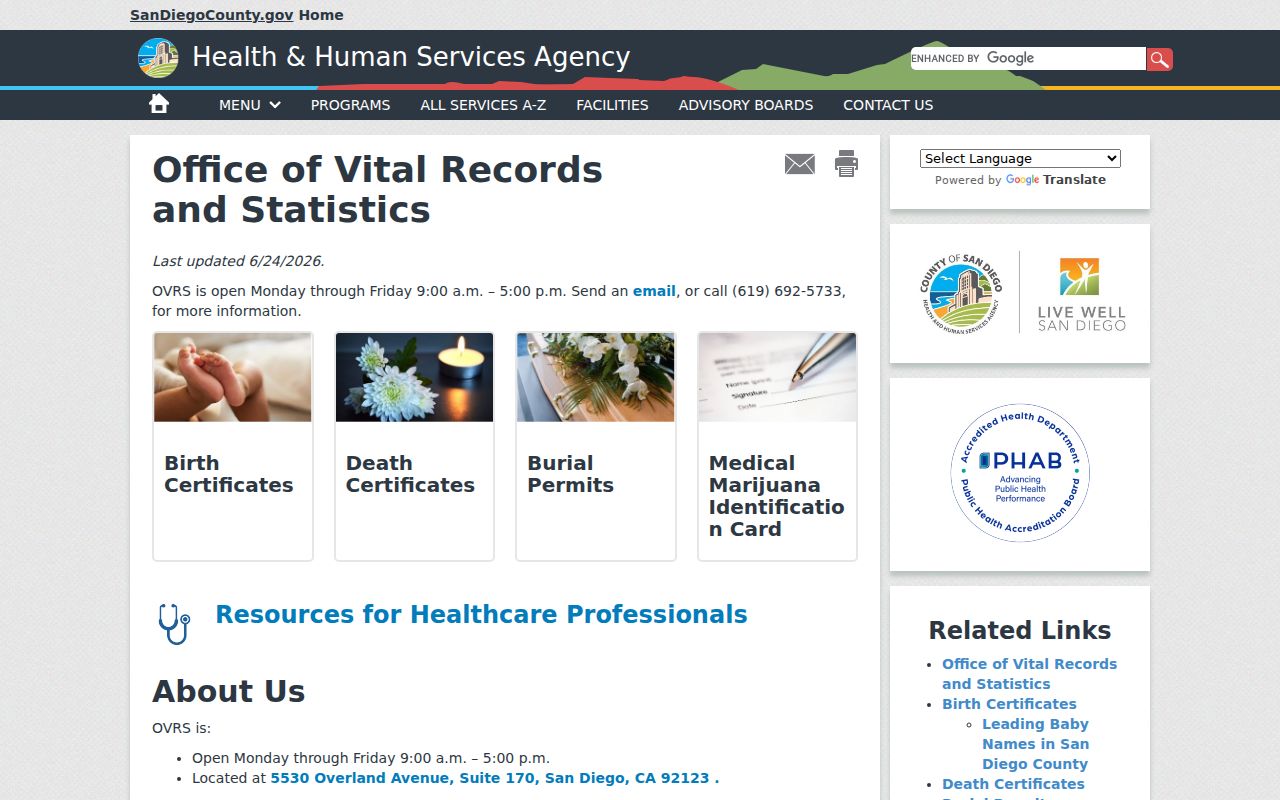
The County Office of Vital Records and Statistics is at 5530 Overland Avenue, Suite 170, San Diego, CA 92123, and lists 619-692-5733. Its route supports in-person and mail requests, with no e-mail or fax ordering. County birth copies are recorded at $34 for 2026, while CDPH’s state fee is $31. VitalChek adds a $12.95 processing fee, and a Certificate of No Public Record does not return the search fee. A historical index, obituary, or cemetery register is a clue, not a certified certificate.
The County vital-record office screenshot shows the local office route that complements statewide forms.
Use an informational record for family-history context and request a certified copy only through the eligibility route that fits the event.
Finding a San Diego Resident Heir
Probate is a focused route when the research question concerns a deceased person, estate, representative, or heir. Start in the Superior Court probate index, preserve the case number, and inspect the petition, orders, and Register of Actions that are available to the public. Sensitive exhibits may be sealed or redacted. Pair the probate name with the last deed, an obituary, cemetery record, and a later recorded instrument rather than assuming every person named in a filing lived at the property.
The County Archives holds older wills and unusual named-person series, while the California State Archives catalog bridges some older probate and will material on microfilm. Counter and mail routes remain important when the online locator does not supply the file. A probate document can connect a deceased former resident to heirs or representatives, but it does not prove the address of every family member.
Obituary microfilm at the San Diego Public Library reaches back to 1865. Funeral-home pages and cemetery memorials can add clues, but retain the publication date and treat them as secondary until a county, court, or archive record supports the connection.
San Diego Resident Research Routes
Some personal research questions have an official route that is safer than an open name search. Birth-parent or adoptee research should use California’s CDSS adoption-information pathways, including consent, contact preference, and mutual-consent mechanisms where they apply. Original adoption and birth records are not an unrestricted people-search source. Follow the eligibility and privacy process set by the state.
For a former classmate, use San Diego Public Library yearbooks, city directories, the History Center, SDSU or UC San Diego finding aids, and permission-based reunion or alumni material. Keep a source date and avoid assuming a private organization’s roster is public. The San Diego resident lookup can then verify a public role or historical address through an official record, but it should not turn a family or reunion lead into a current-contact claim.
The California unclaimed-property search below is another example of a narrow name clue. It can show an owner name and reporting-holder or city hint, but a claim requires proof and an old location clue is not a current address.
Open the California Controller unclaimed-property search before reviewing the interface.
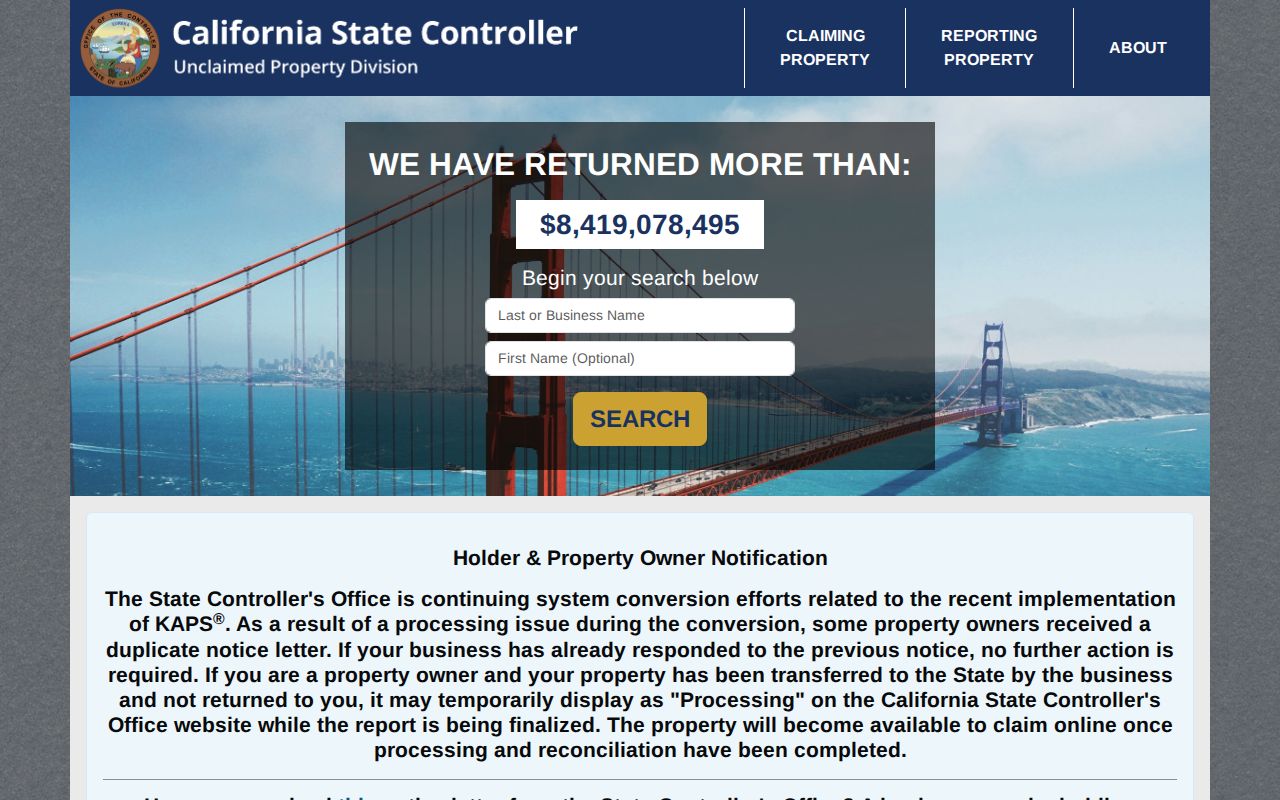
Use that result as a lead to a claim or custodian, not as proof that a person lives in San Diego today.
San Diego Resident License Clues
Professional and business files can add a public affiliation to a resident lookup. DCA’s umbrella search includes board or bureau, license type, license number, business name, first name, last name, registry number, status, and public discipline where displayed. California’s Secretary of State bizfile search covers entities by name or file number, with formation, status, jurisdiction, agent, street and mailing addresses, and filing documents. San Diego County fictitious business name filings add a local DBA route.
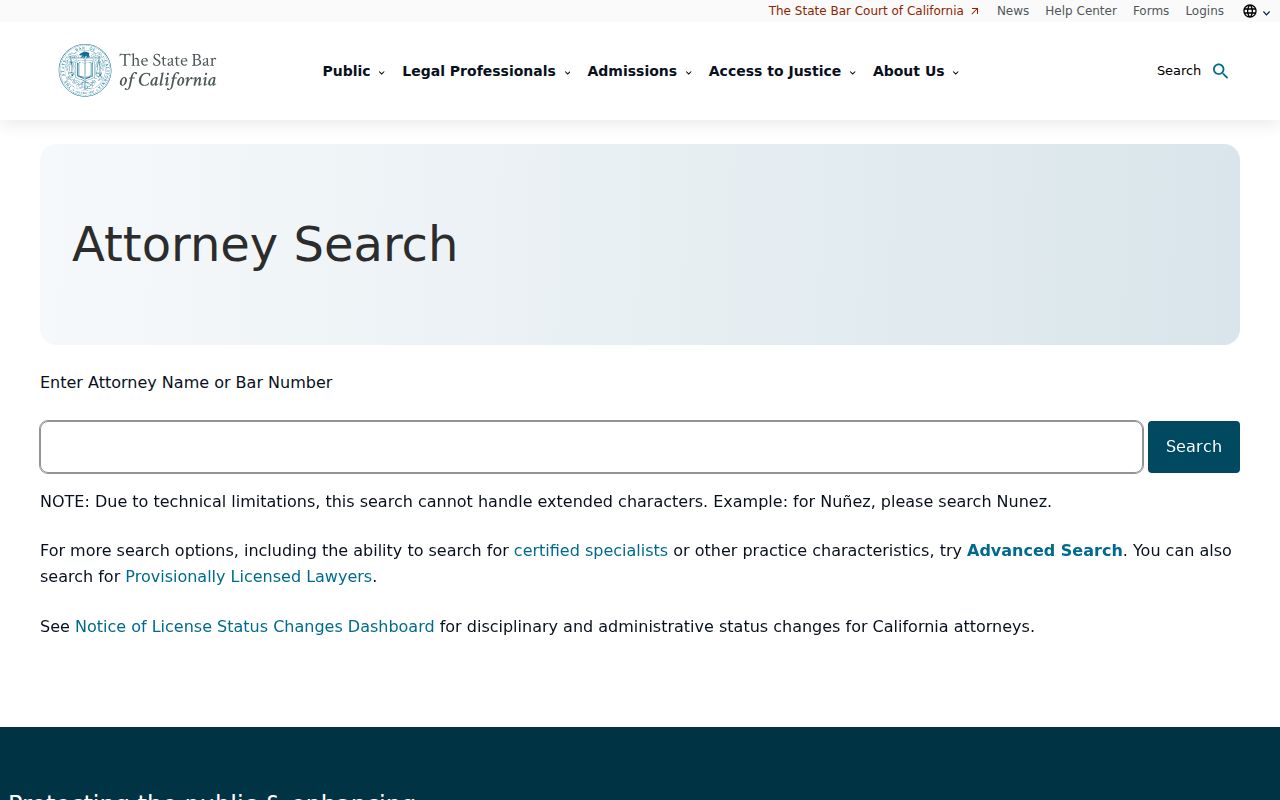
Board-specific portals can be necessary. The State Bar, DRE, CSLB, CTC, medical boards, nursing board, and Alcoholic Beverage Control each control their own data. A no-result in DCA does not prove the person lacks a California credential. An address of record is not a residence, and an agent for service is not automatically a beneficial owner.
The California attorney search screenshot demonstrates why a license result should be quoted by board, license type, status, and date.
Business and license clues are most useful when they agree with a known city, date, middle name, entity number, or public role.
San Diego Resident Lookup Limits
Some trails end by design. Renters, family members, roommates, utility customers, DMV addresses, protected voters, sealed cases, confidential marriages, and adoption files do not form an open resident roll. California’s Safe at Home program offers a substitute mailing address and related protections for eligible participants, but it does not rewrite identity or guarantee removal from every private compilation. The California Consumer Privacy Act and DROP apply to covered businesses and brokers, not a recorder, court, assessor, or election office performing a legal public duty.
Lawful use. A San Diego resident lookup is for personal, lawful research, family history, reconnecting, and civic understanding. Using a record trail to stalk, harass, intimidate, or harm any person is prohibited.
Corrections belong with the source custodian: ARCC for property or recorded-document issues, the Registrar for voter records, the filing court for a case index or file, the licensing board for credential data, and the Secretary of State for a business filing. A focused California Public Records Act request can seek an existing nonexempt record, but it cannot require an agency to create a biography or override a confidentiality rule.