
How San Diego Residents Directory Searches Begin
Start with the question itself. A San Diego residents directory search earns its accuracy from knowing what each record actually proves. An assessed owner is tied to a parcel. That person may not live there. A voter lookup confirms one voter and never opens a browse-by-street roll. A court hit places a party in a case. It says nothing about the outcome. Printed directories fix people at a moment in time, and a business or professional license shows only a public affiliation.
Fit the path to the evidence. An address leads to a parcel first, along with its legal description. A current name may point to a license, business filing, court index, or official vital-record route. An old household belongs in city directories, telephone books, census schedules, newspapers, cemetery records, and probate files. A missing result can mean a restricted record, a spelling variation, a changed parcel, or a plain source gap. Date every answer. The directory works best when each result is checked against another identifier before it becomes part of the picture.
- Start with the San Diego County Parcel Lookup or a SanGIS address point to connect a street address with its APN and situs record.
- Use the County Assessor, Recorder, or a focused state lookup according to the question, keeping owner, mailing address, and public affiliation separate.
- Run the San Diego Superior Court party index with case type, location, year, name, and optional birth date when a court trail matters.
- Use the authenticated Registrar of Voters check only for an eligible self-lookup, and treat historical directory and obituary sources as time-specific evidence.
- Request an existing nonexempt record from the custodian when an online index ends, using a document number, address, date range, or case number.
Note: A result stays a lead until its custodian, date, role, and underlying record all agree with the other evidence.
Where San Diego Keeps Resident Records
San Diego keeps records on four levels of government. Most of it starts with the San Diego County Assessor/Recorder/County Clerk, the office known as ARCC. ARCC holds recorded documents, property assessment information, marriage records, fictitious business names, and local vital-record services. The Registrar of Voters controls voter access. The Superior Court keeps case files, including probate. City Clerk records, Development Services files, libraries, and archives fill the older and municipal gaps.
Each office answers one question well. ARCC can show a grantor, grantee, or recording date. The same office tracks document type, APN path, and legal description. The assessor connects a public parcel record to a situs and tax mailing address. The court index places a party in a case family and courthouse. A library shows a household in a directory year. A records request asks for one identifiable record, not an order to create a list of residents.
San Diego County Assessor
Parcel and property records
San Diego County, CA
619-236-3771
ARCC copy orders run through web instructions, public kiosks, mail, or the counter and County Archives. Assessor questions have phone, kiosk, and parcel routes. Voter access is narrower by design. Keeping those channels in view avoids the common mistake of stopping at a portal that only exposes an index.
San Diego Parcel Lookup by Address
An address in hand points to one tool first. The San Diego County Parcel Lookup Tool carries documented search options for property or street address, APN, owner name, and map or rooftop location. That range does not make the tool an unrestricted owner-name sweep. Enhanced reports may sit behind a gate. The county's phone and kiosk route stays a real fallback. A parcel result can show property address, APN, owner, owner mailing address, legal description, use type, tax-rate area, assessment values, zoning, and property characteristics.
Read each field as a separate key. The situs address is the physical location of the parcel. The tax mailing address is where assessment correspondence goes. The legal description names a tract, lot, block, or metes-and-bounds parcel. It survives changes to an address or an APN. No single field proves who occupies a building. The parcel image shows the address-and-APN interface that starts an evidence trail, and the County Parcel Lookup source handles the address-to-record handoff.
An APN anchors the next step. With it, the recorder search can be run by party name while the parcel is checked against maps, permits, and tax information.
- Parcel
- A mapped property unit with an APN and legal description.
- Roll
- An assessment or registration list maintained for a defined public purpose.
- Index
- A guide to a record, not always the image or certified copy.
- Criss-cross directory
- A reverse directory arranged by street or address rather than surname.
Note: One parcel can carry several addresses or units, and a situs point can differ from a house, owner, or mailing address.
San Diego Deeds for Resident Research
The ARCC Official Records Index reaches 1970 to the present online for party-based searching. It shows indexed name, role, recording date or year, document number, and document type. The image is not a free web result. Public kiosks and paid copy channels supply image access, and the County Archives bridges much older material. Online APN searching ended December 9, 2024 under AB 1785, so the current address-to-deed route is usually assessor or GIS to APN or owner, then recorder party search.
When the web index is not enough, use the counter, kiosk, mail, or archive. A mailed copy request should include the document number, year, at least one party, and document type. ARCC’s published route is P.O. Box 121750, San Diego, CA 92112-1750; the Recorder phone is 619-238-8158 and the general Recorder/Clerk number is 619-237-0502. County Archives at 10144 Mission Gorge Road in Santee holds deeds from 1845-1930, grantor and grantee indexes from 1846-1969, numeric indexes from 1872-1973, and map series from 1854 forward.
The index tells where to look. The deed image supplies the operative legal description and transfer terms. A grantor is the party conveying an interest; a grantee receives it. A lien, reconveyance, quitclaim, trustee instrument, or corrective document should not be treated as a simple sale. For family history, deeds can connect a name to land without turning the name into proof of residence.
Today’s San Diego Resident Directory Sources
No single current San Diego resident directory exists today. Instead, public sources fill the gap. Each has its own scope and access rules. A property roll is the strongest tool for an assessed owner and parcel. Court indexes do their best work when you need a case party. A business filing or professional license reveals a public-facing affiliation. Voter tools exist for a person to authenticate their own record. Planning contacts list civic points of contact, not member households.
| Source | What It Lists | Keeper | Access and Limit |
|---|---|---|---|
| Parcel assessment | Owner, situs, mailing address, APN | San Diego County Assessor | Public parcel route; owner is not necessarily an occupant |
| Official-record index | Grantors, grantees, liens, document dates | ARCC Recorder | Free index; images and copies use kiosks or paid channels |
| Voter registration check | One voter’s status and election information | Registrar of Voters | Authenticated self-check; not street browsing |
| Business and license files | Entity, agent, license, or public address of record | California SOS and DCA | Free search; affiliation is not residence |
| Old directories and archives | Named people by year, address, or occupation | SDPL, City Clerk, History Center | Historical and onsite or digitized access |
Role labels matter when you search. A San Diego residents directory works best when every name keeps its source label attached. That way a licensee is never mistaken for a resident at an address. The California Secretary of State business search and the DCA license search can separate a public business role from a mere address clue. Name a business agent, licensee, or filing contact by that role.
Note: Searching a current source is often free. A certified copy, image, or archive consultation goes through a separate fee or access channel.
San Diego Voter Lookup Self-Check
The San Diego Registrar of Voters lookup lets one person check their own registration record. House number, street name, street type, and ZIP Code fill the address fields. Optional directions and a full birth date complete the authentication. Results may include voter information, vote centers, a pamphlet, and elected representatives. A no-match can mean a mistyped address or birth date. It can also mean a move outside the county. It can mean a card still processing. Or it can mean an identity detail that is not on file.
California voter data is not a general name directory. Elections Code sections 2188 and 2194 restrict who may receive a file. Related rules restrict why. Election, scholarly, journalistic, political, governmental, and own-record uses all require an application. The application states identity, purpose, safeguards, and a perjury certification. A specific-voter request can demand exact full name, birth date, and residence address. A block-wide request from an unidentified requester is simply not the same thing.
The San Diego voter registration page illustrates that self-check role rather than any public roster.
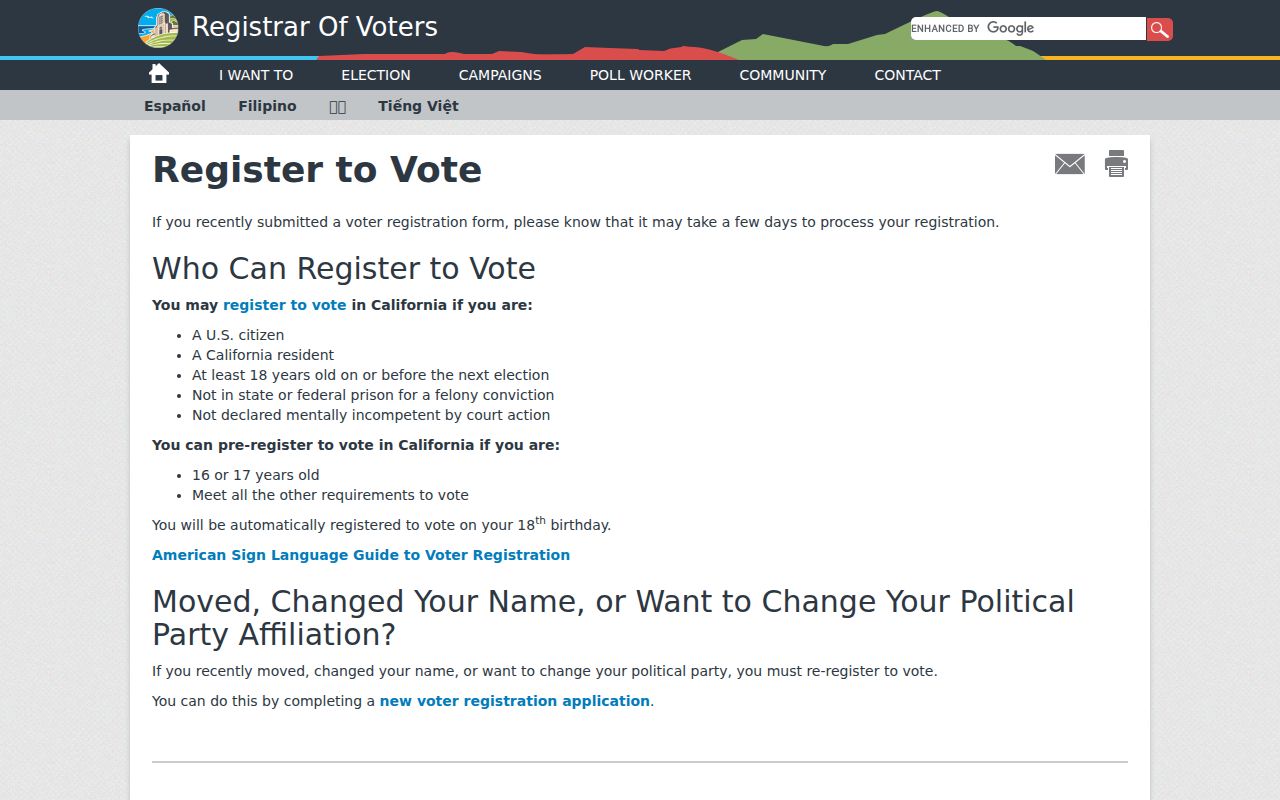
Treat the lookup result as a single dated clue. It is a snapshot, not proof. A self-check can still help a person reviewing their own voter record, yet it misses renters, family members who share an address, protected voters, and anyone unregistered, so the gaps stay real.
| House number | Numeric residence component used for authentication. |
|---|---|
| Street name and type | Separate fields for the base road and suffix. |
| Birth date | Month, day, and year used with the address. |
| ZIP Code | Five-digit delivery geography supplied by the voter. |
When a San Diego Records Request Helps
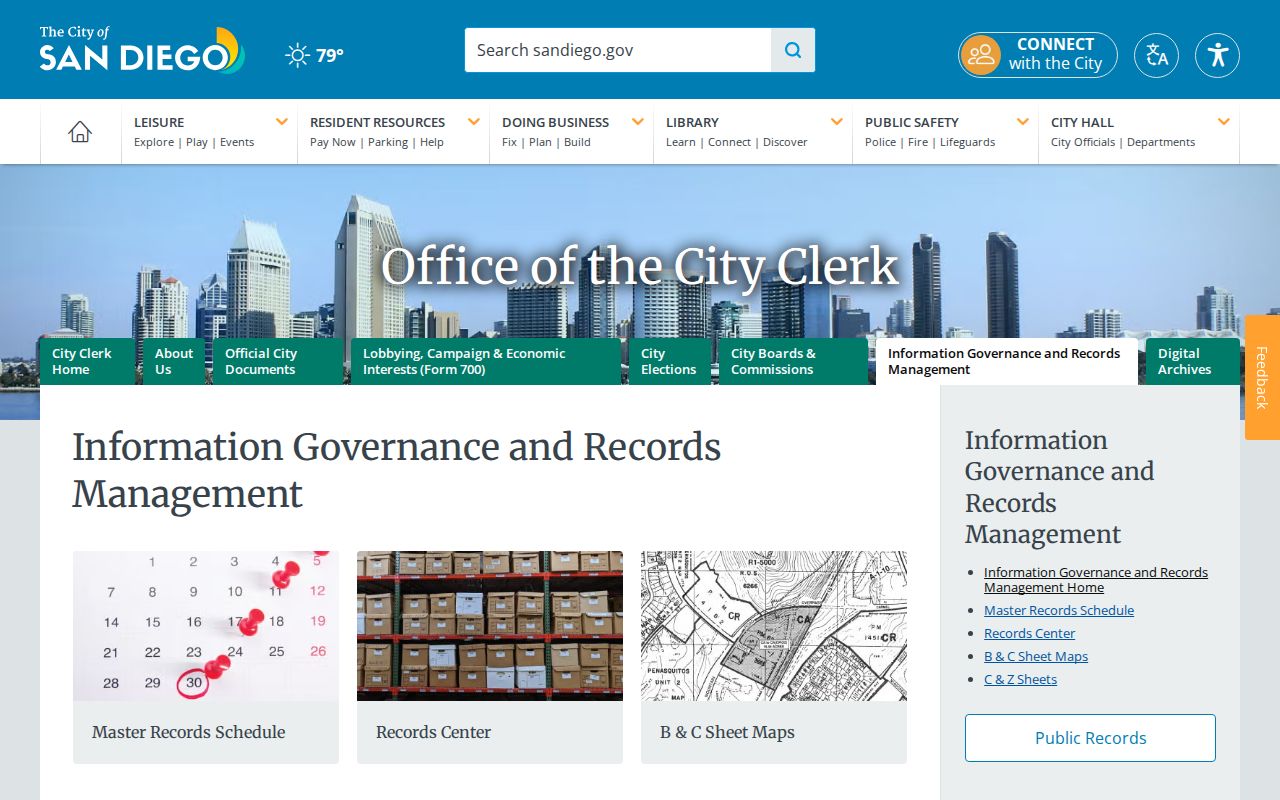
The City Clerk records page is the municipal recordkeeper's front door. San Diego's City Clerk runs an Information Governance and Records Management division. It maintains a Master Records Schedule and operates a Records Center. It fields public-record requests and preserves historical city materials. The Digital Archives at 202 C Street offers search help and recently added collections. Scale matters here. The Records Center holds more than 42,000 boxes across 14 secure sites. That is why a focused request often succeeds where a web search stalls.
A good records request names what you want. Use the City Clerk records information and Digital Archives channels to supply a department, an address, and a project or case number. Include a record type and a date range too. The California Public Records Act is set out at Government Code sections 7920.000 and following. It gives an agency ten days to make a determination. Unusual circumstances can add fourteen more. That clock covers the determination, not the production itself. The city need not create a new analysis or override a privacy exemption.
The page image below shows the municipal records route that supports a focused request.
Development Services opens another channel. OpenDSD carries most San Diego permit and project data from 2003 forward. Accela holds several categories submitted after January 16, 2018, while post-1955 files require a Records Review appointment and pre-1955 building records route to the Assessor.
San Diego Historical Resident Directories
Old San Diego directories begin with an 1874 city and business volume. The series stretches through a run advertised onsite as late as 2021. The San Diego Public Library California Collection covers city directories from 1886 through 2021. San Diego Yesterday links digitized volumes covering 1887 to 1925. City Clerk scans add 1874. They add annual volumes from 1926 through 1943, combined editions for 1944-45 and 1947-48, then 1950, 1952, 1953-54, a 1955 suburban book, city and suburban volumes from 1956-58, and suburban volumes from 1959-60. For anyone tracing past residents of San Diego, this shelf of city directory scans is the spine of the paper trail.
What does a typical entry hold? A name, an address, and an occupation come standard. Later books may add a spouse in parentheses. They may add an employer, residence marks like `h` or `r`, and widow notation. Many volumes carry a reverse or criss-cross section. It turns an address into that year's roster of people and businesses. The San Diego Directory Book page lays out the full shelf, scan, and reading workflow. Remember one thing above all. A directory is a printed snapshot, not a current resident roll.
San Diego Local History for Directories
Directories sit inside a wider local-history landscape. The San Diego Public Library California Collection pairs them with the Great Register for 1888-1892, more than 800 maps and Sanborns, and San Diego Union material reaching back to 1868. Its genealogy collection holds over 10,000 books and 1,000 periodical titles. Special Collections keeps hours worth planning around: Monday and Tuesday 11:30 a.m. to 8 p.m., Wednesday through Saturday 9:30 a.m. to 6 p.m., closed Sunday. Ancestry Library Edition works only inside the building, so remote searching cannot fully replace a visit.
Other channels carry different pieces of the puzzle. The San Diego History Center Research Archives, UC San Diego Special Collections, SDSU Special Collections, the California State Archives, and the City Clerk Digital Archives each impose their own finding aids and access limits. Union obituary microfilm runs to 1865. City Clerk burial collections split Mount Hope, IOOF, Masonic, the Chinese Burial Index, County Burials, lot-owner books, and interment tickets. A name absent from one collection often turns up in another.
Note: Treat directory absence as negative evidence only after checking alphabetical, street, suburban, late-addition, spelling, and abbreviation sections.
San Diego Court Lookup Records
The San Diego Superior Court Index is a free locator. It covers civil, criminal, family or domestic, mental-health, and probate cases. Online coverage runs from 1974 to the present. Older material lives at Central Division Older Records. That office holds indexes from 1880 to mid-1974; hardbound books cover 1880-1964, and computer-generated indexes pick up after 1964. Juvenile and traffic or minor-offense cases stay out of the online index. Some older limited civil and misdemeanor entries also have shorter availability.
The party search accepts case type and an optional location. It also takes party type where it applies, plus beginning and ending filing years. Name fields include a last or business name, an optional first name, and an optional date of birth. Results can show case title, case number, file location, case type, filing date, and parties. Charges and disposition do not appear at the index level. The official file or Register of Actions is the next step. It can be reached through online options where offered, the courthouse counter, kiosks, or mail.
Copy access works separately from the locator. Court guidance lists $0.50-per-page copies. A search fee applies when a nonparty request runs past ten minutes, with possible certification and retrieval fees. Mail requests need a case number, requested documents, contact details, envelope, and payment. A hard-copy request can take weeks. Treat an index hit as case placement only, until the underlying record has been inspected.
San Diego Vital Records for Lookup
Vital records split across several custodians. Birth, death, marriage, and divorce records each follow their own access rules. San Diego County ARCC and the County Office of Vital Records and Statistics issue local certificates. The California Department of Public Health handles statewide applications. Informational copies may be broadly available for certain births, deaths, and public marriages. Authorized certified copies, which can establish identity, require an eligible requester plus a sworn statement. Confidential marriage records stay limited to the spouses, a court-order route, or a qualifying representative. Those limits sit in Health and Safety Code sections 103526 and 103526.5 and Family Code section 509.
Fees differ by office. In the current 2026 comparison, a San Diego County birth copy costs $34. A CDPH birth copy costs $31. County public-health services at 5530 Overland Avenue, Suite 170, take in-person and mail requests. In person, payment may be cash, card, tap, check, or money order. Mail takes check or money order. Regular mail is free, UPS runs $19, and VitalChek adds $12.95 in processing. CDPH forms, eligibility, and statewide fees remain a separate route. A historical index or obituary can suggest that an event happened. But it is never a certified certificate.
- Birth
- Local source: County OVRS, ARCC, CDPH. Public clue: Event, date, place, family details. Certified access: Authorized requester with sworn statement.
- Death
- Local source: County, ARCC, CDPH. Public clue: Death event and possible kin link. Certified access: Rules vary by copy type.
- Public marriage
- Local source: ARCC or CDPH. Public clue: Names, date, public marriage record. Certified access: Authorized or informational copy.
- Divorce
- Local source: Superior Court, limited CDPH verification. Public clue: Case or verification clue. Certified access: Decree comes from the court.
San Diego Names in Two Records
A name match gets stronger when geography and time agree with it. Compare the APN or legal description, and compare the court location, the business city, license dates, a former address, an occupation, a spouse notation, or a family link. Keep each result tied to its role. A registered agent is a statutory contact, not automatically an owner. An assessed owner may not be the resident. A court party may not live at the nearby parcel. A license address is an address of record, not proof anyone dwells there.
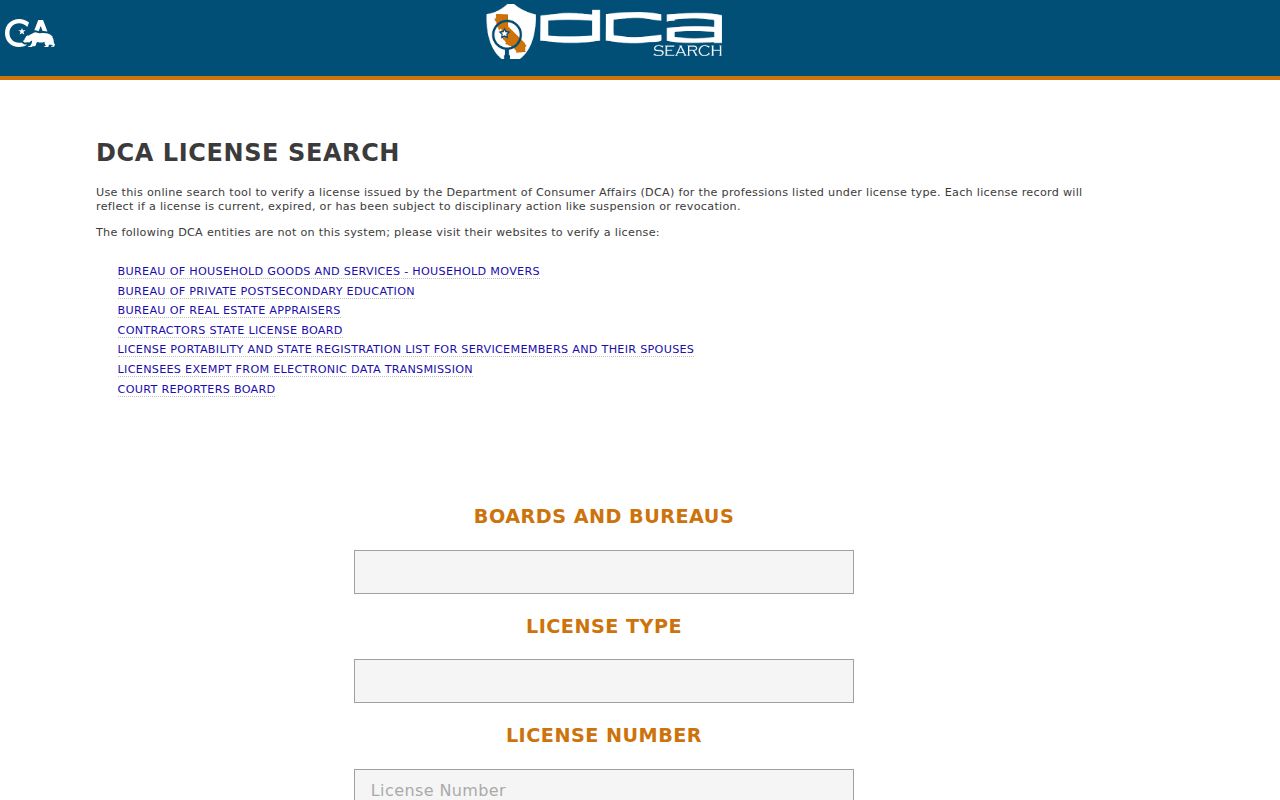
For a public role or professional tie, the California Department of Consumer Affairs license search can show board, license type, number, name, status, dates, address of record, and any public discipline. The board displays that discipline itself. The Secretary of State bizfile search returns entity name or file number, formation or registration date, status, jurisdiction, agent, street and mailing addresses, and filing history. Fictitious business names come from ARCC. The DCA license search screenshot below shows an official name search. It carries a defined public scope.
For an entity clue, the bizfile business search screenshot shows a different record family. Treat it as a business filing, not a household list.
When two people share a name, keep the exact spelling, initials, former surnames, source dates, and record roles side by side. If doubt remains, ask the custodian for a specific existing copy. Do not ask an office to decide whether two people are the same person.
Official Rolls and Commercial Compilations
Official records and commercial people-finder compilations serve different purposes. The official source sits closer to the originating event and exposes its own limits. A commercial compilation can blend public and nonpublic data. It can merge people with similar names, lag behind a move or a death, or recycle an old phone or address. It works as a lead for reconnecting with a relative or checking a possible scam. It is no substitute for the custodian's record.
| Source type | Strength | What to verify |
|---|---|---|
| County or state record | Defined custodian, date, role, and access rule | Index versus image, eligibility, currentness |
| Library or archive collection | Time-specific names, addresses, and context | Publisher key, gaps, scan quality, onsite limits |
| Commercial compilation | May gather clues across many sources | Identity merge, stale data, lawful personal use |
Check the custodian. San Diego public records can be researched for lawful personal purposes, family history, civic understanding, and consumer safety. Do not use a name or address trail to stalk, harass, threaten, or harm anyone.
San Diego Privacy Changes in 2026
California's new privacy tools affect downstream commercial data, not the public source record. The Delete Act and DROP portal let a California resident send one encrypted deletion or stop-sale request. That request goes to more than 500 registered brokers. Requests began in 2026. Broker deletion duties began August 1, 2026. That process can remove or suppress covered commercial copies. It does not erase a deed, court index, assessor record, or other government record held under a public duty.
For a source record, contact the custodian under the rule that applies. Voter, court, recorded-document, and license redactions each run on their own statutes and programs. The Secretary of State's Safe at Home program offers a substitute mailing address, mail forwarding, and related protection for eligible participants. Those participants include qualifying victims and threatened public workers. It is prospective, and it does not guarantee an old address disappears everywhere. A protected person should work with the program first. That step should come before making a record request or recording an instrument.
Note: A downstream opt-out and a government-record correction are different requests sent to different custodians.
San Diego’s Long Records Memory
San Diego County was created in 1850. But the record trail reaches earlier through deeds, indexes, maps, and land descriptions. The County Archives preserves grantor and grantee indexes to 1846 and deeds to 1845. Before online search, a researcher worked through books, microfilm, shelves, counters, and finding aids. That older system still matters. The recorder web index begins in 1970, and the Superior Court online index begins in 1974.
San Diego's preservation history has its own story. In 1889, Mayor Gunn called for a fire-proof vault for City Clerk records. In 1959, the city weighed a remote repository for vital records. It was meant to guard against an atomic disaster. Later archival work helped inventory large bodies of city material. That work included a 1986 National Historical Publications and Records Commission grant. Today's Records Center uses more than 42,000 boxes across 14 sites. It also handles conservation, microfilm, digitization, and a conversion lab for obsolete formats.
That history explains why the San Diego residents directory works as a network of records. It is not one database. Use the live portal when it reaches the needed year. Then move to the kiosk, counter, mail route, library, archive, or court file holding the missing layer. Search spelling variants in OCR scans. Inspect the original page when possible. Record the date of every result.