
San Diego City Directories Across the Years
San Diego city directory collections are split between free scans, linked online volumes, and shelves that require a visit. The San Diego Public Library California Collection advertises a run from 1886-2021. San Diego Yesterday links scans from 1887-1925. The City Clerk Digital Archives carries a separate run of named volumes. The dates overlap, but they are not interchangeable: a shelf year may exist even when a city scan is missing, and a combined volume may stand in for more than one publication year.
| Collection | Years | Where Held | Access |
|---|---|---|---|
| Early city and business directory | 1874 | City Clerk Digital Archives | Free PDF |
| San Diego Yesterday scans | 1887-1925 | Linked through SDPL | Online scans |
| City and suburban directories | 1926-1960, with combined and listed gaps | City Clerk Digital Archives | Free online scans |
| SDPL California Collection | 1886-2021 advertised onsite run | Central Library shelves | Onsite research |
| Telephone and community directories | 1906 onward, collection dependent | History Center and library collections | Archive or onsite access |
The coverage table is a starting map, not a claim that each year is annual or complete. Check the exact shelf or scan before promising a year to a family-history researcher.
San Diego Directory Predecessor
The earliest item in the local run is Information Relative to San Diego, California, Containing Also a Business Directory of the City, issued from the office of the San Diego Daily Union in 1874. It is best described as an early city and business directory, not silently folded into an uninterrupted annual series that begins on the library shelf in 1886. That distinction matters when a surname appears in an early business context but not in a later household section.
The 1874 volume is a free PDF in the City Clerk city-directory collection. Search the scan with spelling variants, then inspect the printed page because OCR can misread old type. Use the title page, section heading, and page number in a research note. A name in a business listing may identify a proprietor or public contact, but it does not by itself establish a residence.
- Record the title and page before copying the name.
- Separate city businesses, officials, and household listings.
- Compare the name with a deed, newspaper, census, or later directory.
- Keep the 1874 date attached to the clue rather than treating it as a current fact.
The title-page story gives the San Diego directory shelf a local beginning and a clear source boundary.
Early-volume caution. The 1874 predecessor is an important local source, but it is not evidence that a complete annual directory existed for every year after publication.
Which San Diego Directory Years Are Online
The City Clerk digitized collection lists 1874; annual 1926-1943; combined 1944-45 and 1947-48; 1950; 1952; 1953-54; 1955 suburban; city and suburban 1956-58; and suburban 1959-60. San Diego Yesterday supplies a different online run from 1887-1925. The gaps between those lists are research facts, not proof that a directory was never printed.
The City Clerk digitized-directory source screenshot below is the online part of the San Diego city directory search.
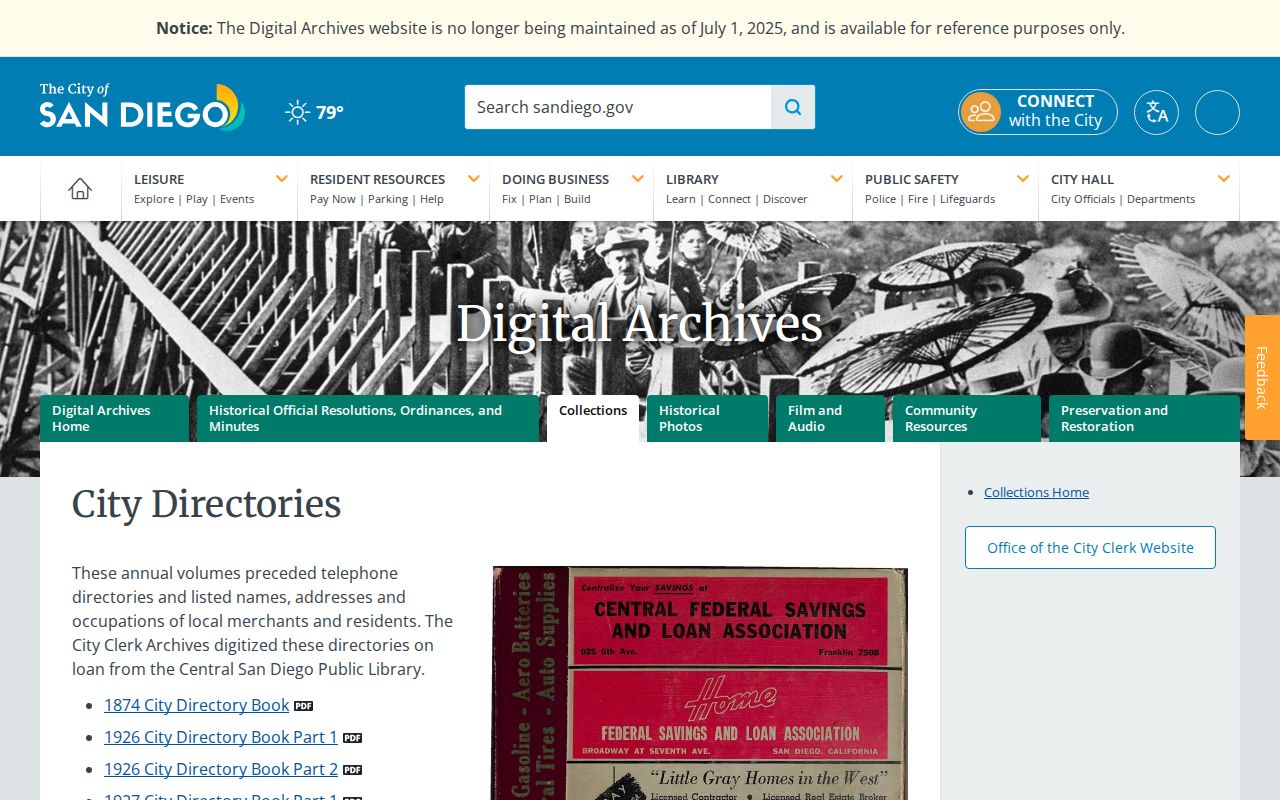
Use the scan for a surname or street lead, then compare the result with the SDPL shelf or History Center collection. Combined years need special care. A person absent from a 1944-45 volume may appear in the next available issue without any exact move date.
OCR improves discovery but does not replace the page. Try initials, Spanish compound surnames, alternate spellings, widow notation, and business names. Photograph or transcribe the abbreviation key before interpreting `h`, `r`, or another mark.
Reading a San Diego Directory Entry
A San Diego city directory entry is a compact record with a publisher’s own shorthand. Commonly supported fields are personal or business name, street address, and occupation. Later alphabetical volumes may add a spouse in parentheses, an occupation or employer, a home mark, a rooming or residence mark, or a widow notation. Do not assume every run uses every field. Read the key printed in that volume.
| Name | Often surname first, followed by given name or initial; a spouse may appear in parentheses. |
|---|---|
| Occupation | A historical role or trade that helps separate people with the same name. |
| Address | House number and street, with the period’s spelling and suffix. |
| Home mark | `h` may indicate home or residence in a particular volume. |
| Widow notation | A phrase such as “wid Charles” can point to a family transition. |
The entry is a time-stamped printed clue. It may describe a householder, boarder, renter, subscriber, or business contact depending on the publisher and notation. It does not certify ownership. A repeated address and compatible family details make the clue stronger, but absence can reflect omission, a move between publication dates, or a different index convention.
- Criss-cross section
- The street-ordered half of a directory, useful for moving from an address to names.
- Householder index
- A name or household arrangement that helps locate the main entry in a volume.
- Abbreviation key
- The publisher’s legend for marks and short forms; read it before expanding a notation.
- Enumeration
- A counted listing made for a defined time and purpose, not a complete list of everyone present forever.
San Diego Public Library’s Directory Shelf
The San Diego Public Library California Collection is the main local shelf for city-directory research. It also holds the Great Register for 1888-1892, more than 800 maps and Sanborns, and the San Diego Union from 1868 onward. The broader genealogy collection has more than 10,000 books and 1,000 periodical titles, with Ancestry Library Edition available onsite. Special Collections is open Monday and Tuesday from 11:30 a.m. to 8 p.m., Wednesday through Saturday from 9:30 a.m. to 6 p.m., and closed Sunday.
Bring the exact year, surname variants, street spellings, and a research question. Ask staff about fragile-volume handling, photography, scan rules, and whether a desired year is on the shelf or in another collection. Remote researchers should not assume that an in-library database or physical directory can be opened from home. The library’s obituary microfilm reaches back to 1865 and can help explain why a person disappears from a directory.
The California Collection source screenshot shows the local-history shelf’s broader context, where a city directory sits beside maps, newspapers, and genealogy resources.
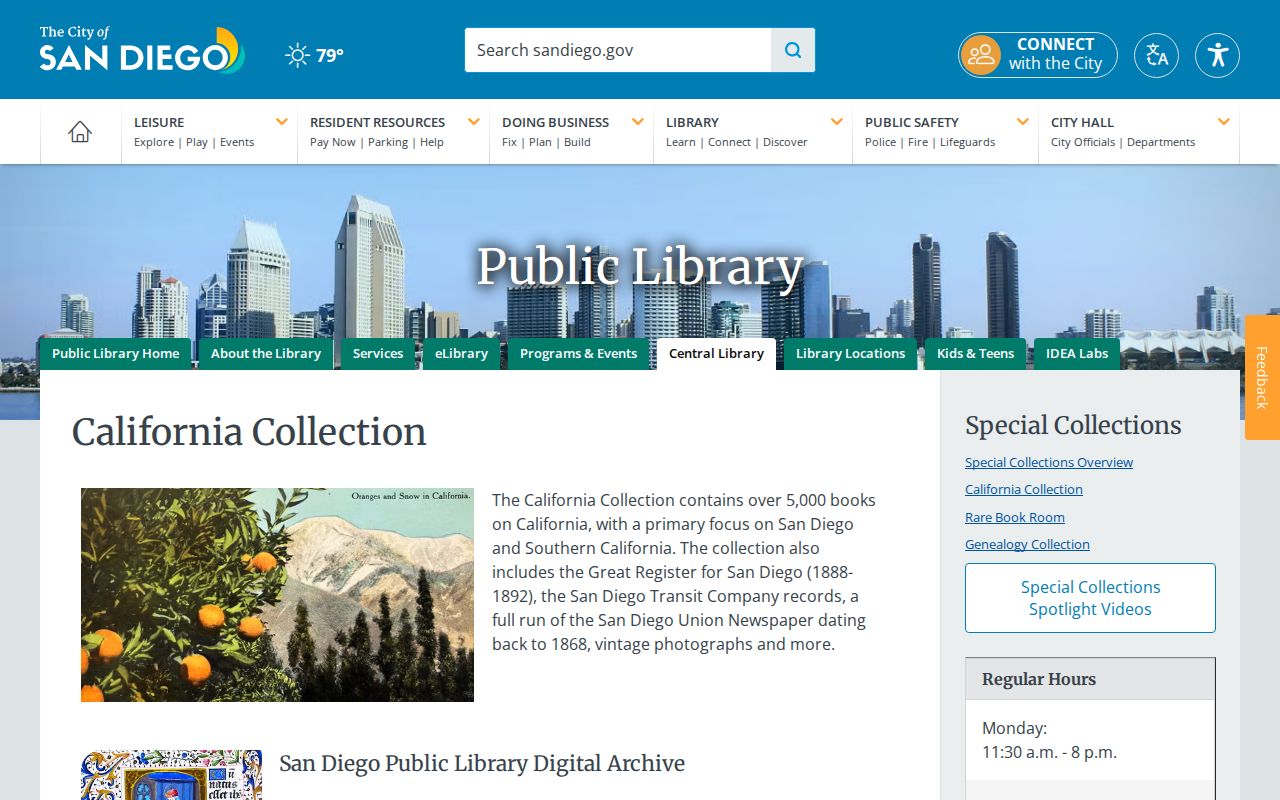
That surrounding material is often what turns one directory line into a defensible family or house-history lead.
San Diego Directory Archive Access
The San Diego History Center Research Archives is a separate channel for city directories, telephone books, community directories, photographs, oral histories, and local organization records. Its research description reports 45 million documents and 2.5 million images beginning in the 1860s. Access is public, but finding aids, donor terms, processing status, and fragile materials can shape what is available.
Telephone directories documented from 1906 onward can provide subscriber and address clues, while community directories may reflect a narrower association or neighborhood. Treat those sources as a different record family from the printed volume. A subscriber, business, organization contact, and householder may be different people. Compare the alphabetic and street sections, retain the publication year, and check the newspaper or deed trail before drawing a family conclusion.
The History Center Research Archives is useful when the San Diego city directory shelf ends or a telephone-era clue needs context.
SDSU Special Collections and University Archives add another local-history channel, including San Diego Memorabilia from 1868-1976 and a San Diego Vertical File spanning 1820-2006.
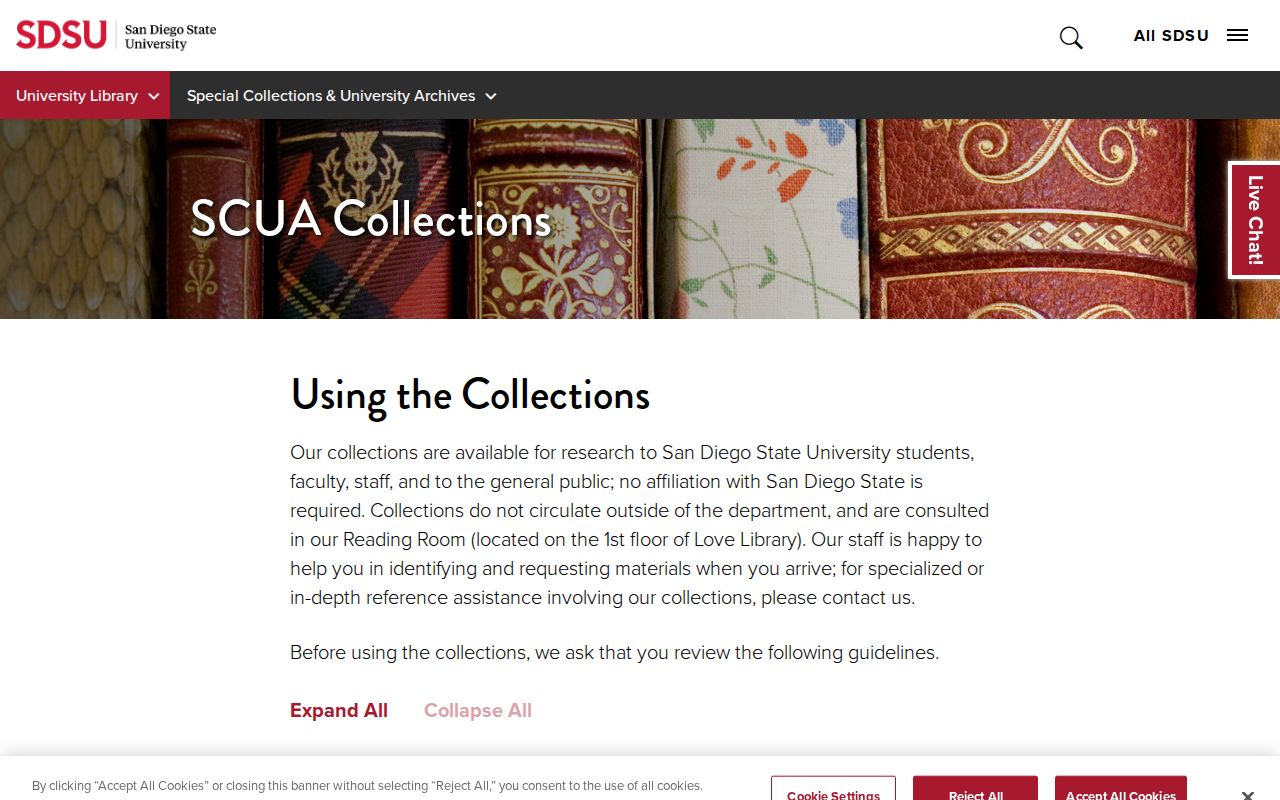
The university image belongs beside the library and History Center routes because archival access depends on collection creator, finding aid, and donor restrictions.
Tracing San Diego Directory Households
Family-history research works best as a dated sequence. Start with one person, address, spouse, occupation, or known event. Move through available directory years, then use a reverse section to test the address. Pair each decade with the federal census schedules released through 1950 under the 72-year rule. Use newspapers, cemetery records, and probate to explain a death or family change rather than treating a missing directory line as proof.
- Choose the nearest reliable directory year and copy the full entry, abbreviation key, address, and source page.
- Search forward and backward for the same surname, initials, spouse, occupation, and address.
- Flip to the reverse section when present and record nearby names without assuming they are relatives.
- Pair the directory with a released census year, noting the household relationship and enumeration geography.
- Use the San Diego Union obituary microfilm, cemetery registers, probate index, or deed record to close or redirect the trail.
A directory disappearance can mean a move, death, omission, publication gap, surname change, or a change in the publisher’s coverage. The best conclusion comes from convergence: a matching address, family detail, date, and independent record.
Note: A directory year gives an approximate household snapshot; it does not establish a continuous presence between publication dates.
San Diego City Census and Great Register
Two local collections help bridge the space between directories and federal census schedules. The City Clerk document collection includes city census material from 1891-1898. The San Diego Public Library holds the Great Register for 1888-1892, a voter-name history with its own eligibility and historical limits. These sources do not form a current resident roll, but they can place a name in San Diego during a defined period.
Read the collection title and purpose first. A Great Register entry is not the same as a directory household entry. A city census enumeration is not the same as a deed or a current voter authentication. Use the address, occupation, age, birthplace, or naturalization detail only as the source displays it, then compare the name with a directory, newspaper, cemetery, or probate record.
The 1890s record gap is a useful reason to search across shelves instead of assuming one database holds the answer.
San Diego Maps Reconnect Old Addresses
Maps help when a directory street label no longer matches a modern address. City historic-map holdings include census-enumeration maps from 1910-20, 1940, 1950, 1957, and 1960; urban-development and city-growth maps; a 1924 Block Map; and an 1984 ZIP map. Sanborn coverage called out for San Diego includes 1921, 1942, and 1956. A map can show a block, footprint, subdivision, or street continuity that is hard to infer from a name index.
The historical-map collection screenshot below shows why maps belong beside a San Diego city directory rather than in a separate research silo.
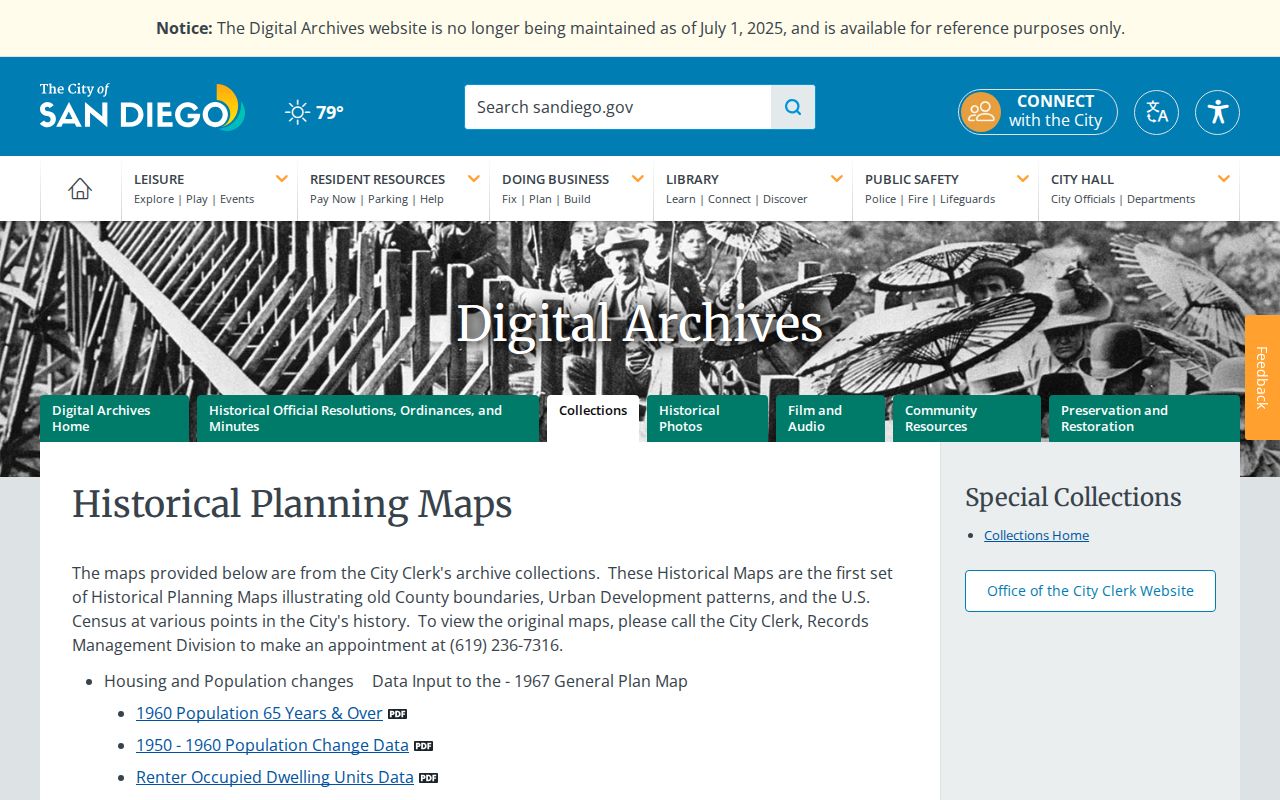
When a street number appears to drift, compare the legal description, tract or lot, subdivision map, period street guide, Sanborn sheet, and active or inactive road layer. Research did not locate an authoritative citywide renumbering chronology, so a single invented change year would be weaker than a documented map bridge.
Why San Diego’s Directory Shelf Survived
San Diego’s records history gives the local directory collection a wider preservation story. In 1889, the mayor called for a fire-proof vault for City Clerk records. In 1959, the city considered an outlying repository for vital city records in an atomic-disaster contingency. Later preservation work used inventory schedules, microfilm, Mylar, Japanese paper, wheat paste, and digitization. Word-searchable scans improve access, but the printed page and publisher’s key remain the final check.
The City Clerk Digital Archives and the library shelf therefore answer different questions. A scan can make a name findable from home. An onsite volume can fill a scan gap, show a missing page, or reveal a reverse section. A History Center or university archive can add telephone, community, alumni, religious, or neighborhood context. Use the channel that matches the year and record type.
San Diego directory volumes are strongest when read as a sequence of local snapshots, linked to maps and independent records, rather than as a single all-purpose directory.