
How San Diego Residents Directory Searches Begin
A useful San Diego residents directory search begins with the question, not with a promise that one portal can answer everything. An assessed owner is tied to a parcel, but that person may not live there. A voter lookup authenticates one voter and does not open a browse-by-street roll. A court hit shows a party name and case placement, not a final outcome. Printed directories name people at a particular time and address, while a business or professional license shows a public affiliation. Those differences make the search more accurate and protect against treating a clue as proof.
Use the narrowest path that fits the evidence. An address points first to a parcel and legal description. A current name may point to a license, business filing, court index, or official vital-record route. An old household belongs in city directories, telephone books, census schedules, newspapers, cemetery records, and probate. A missing result can mean a restricted record, a spelling variation, a changed parcel, or a source gap. The San Diego residents directory works best when each result is dated and checked against another identifier.
- Start with the San Diego County Parcel Lookup or a SanGIS address point to connect a street address with its APN and situs record.
- Use the County Assessor, Recorder, or a focused state lookup according to the question, keeping owner, mailing address, and public affiliation separate.
- Run the San Diego Superior Court party index with case type, location, year, name, and optional birth date when a court trail matters.
- Use the authenticated Registrar of Voters check only for an eligible self-lookup, and treat historical directory and obituary sources as time-specific evidence.
- Request an existing nonexempt record from the custodian when an online index ends, using a document number, address, date range, or case number.
Note: A result is a lead until its custodian, date, role, and underlying record agree with the other evidence.
Where San Diego Keeps Resident Records
San Diego’s records map crosses city, county, state, and federal lines. The San Diego County Assessor/Recorder/County Clerk, known as ARCC, holds recorded documents, property assessment information, marriage records, fictitious business names, and local vital-record services. The Registrar of Voters controls voter information access. The Superior Court holds case files, including probate, instead of a county clerk acting as a general court-file custodian. City Clerk records, Development Services files, libraries, and archives fill the older and municipal gaps.
Each office answers a different question. ARCC can show a grantor or grantee, recording date, document type, APN path, or legal description. The assessor can connect a public parcel record to a situs and tax mailing address. The court index can place a party in a case family and courthouse. The library can show a household in a directory year. A records request is a request for an existing, identifiable record, not an order for an office to create a list of residents.
San Diego County Assessor
Parcel and property records
San Diego County, CA
619-236-3771
ARCC copy orders can use the web instructions, public kiosks, mail, or the counter and County Archives channels. Assessor questions have phone, kiosk, and public parcel routes. Voter access is deliberately narrower. Keeping those channels visible prevents the common mistake of stopping at a portal that only exposes an index.
San Diego Parcel Lookup by Address
The San Diego County Parcel Lookup Tool is the practical starting point when an address is known. Its documented dimensions include property or street address, APN, owner name, and map or rooftop location, but public access is not an unrestricted owner-name sweep. Enhanced reports may be gated, and the County’s phone or kiosk route remains an important fallback. A parcel result may show property address, APN, owner, owner mailing address, legal description, use type, tax-rate area, assessment values, zoning, and available property characteristics.
Read the fields as separate keys. The situs address is the physical parcel location. The tax mailing address is where assessment correspondence goes. The legal description identifies a tract, lot, block, or metes-and-bounds parcel and can remain useful after an address or APN changes. None of those fields alone proves who occupies a building. The parcel image below shows the kind of address and APN interface that begins an evidence trail.
The County Parcel Lookup source is useful for the address-to-record handoff.
Once an APN is anchored, the recorder search can be performed by party name and the parcel can be checked against maps, permits, and tax information.
- Parcel
- A mapped property unit with an APN and legal description.
- Roll
- An assessment or registration list maintained for a defined public purpose.
- Index
- A guide to a record, not always the image or certified copy.
- Criss-cross directory
- A reverse directory arranged by street or address rather than surname.
Note: A parcel can carry more than one address or unit, and a situs point can differ from a house, owner, or mailing address.
San Diego Deeds for Resident Research
The ARCC Official Records Index reaches 1970 to the present online for party-based searching. It shows indexed name, role, recording date or year, document number, and document type. The image is not a free web result. Public kiosks and paid copy channels supply image access, and the County Archives bridges much older material. Online APN searching ended December 9, 2024 under AB 1785, so the current address-to-deed route is usually assessor or GIS to APN or owner, then recorder party search.
When the web index is not enough, use the counter, kiosk, mail, or archive. A mailed copy request should include the document number, year, at least one party, and document type. ARCC’s published route is P.O. Box 121750, San Diego, CA 92112-1750; the Recorder phone is 619-238-8158 and the general Recorder/Clerk number is 619-237-0502. County Archives at 10144 Mission Gorge Road in Santee holds deeds from 1845-1930, grantor and grantee indexes from 1846-1969, numeric indexes from 1872-1973, and map series from 1854 forward.
The index tells where to look. The deed image supplies the operative legal description and transfer terms. A grantor is the party conveying an interest; a grantee receives it. A lien, reconveyance, quitclaim, trustee instrument, or corrective document should not be treated as a simple sale. For family history, deeds can connect a name to land without turning the name into proof of residence.
Today’s San Diego Resident Directory Sources
There is no complete current San Diego resident directory. The closest public sources have different scopes and different access rules. A property roll is strongest for an assessed owner and parcel. A court index is strongest for locating a case party. A business filing or professional license shows a public-facing affiliation. The voter tool authenticates a person’s own record. Community planning contacts identify civic points of contact, not member households.
| Source | What It Lists | Keeper | Access and Limit |
|---|---|---|---|
| Parcel assessment | Owner, situs, mailing address, APN | San Diego County Assessor | Public parcel route; owner is not necessarily an occupant |
| Official-record index | Grantors, grantees, liens, document dates | ARCC Recorder | Free index; images and copies use kiosks or paid channels |
| Voter registration check | One voter’s status and election information | Registrar of Voters | Authenticated self-check; not street browsing |
| Business and license files | Entity, agent, license, or public address of record | California SOS and DCA | Free search; affiliation is not residence |
| Old directories and archives | Named people by year, address, or occupation | SDPL, City Clerk, History Center | Historical and onsite or digitized access |
The California Secretary of State business search and DCA license search can help distinguish a public business role from an address clue. A business agent, licensee, or filing contact should be described by that role. The San Diego residents directory becomes more useful when the source label stays attached to every name.
Note: A current source can be free to search while a certified copy, image, or archive consultation uses a separate fee or access channel.
San Diego Voter Lookup Self-Check
The San Diego Registrar of Voters lookup is designed for an individual to check a registration record. Its address fields include house number, street name, street type, ZIP Code, optional directions, and a full birth date for authentication. Results can show voter information, vote centers, a voter information pamphlet, and elected representatives. A no-match may reflect a mistyped address or birth date, a move outside the county, a card still processing, or an identity detail that is not on file.
California voter data is not a general name directory. Elections Code sections 2188 and 2194, along with related rules, restrict who may receive a file and why. Approved election, scholarly, journalistic, political, governmental, and own-record routes use an application with identity, purpose, safeguards, and a perjury certification. A specific-voter request can require exact full name, birth date, and residence address. An unidentified request for every voter on a block is not the same thing.
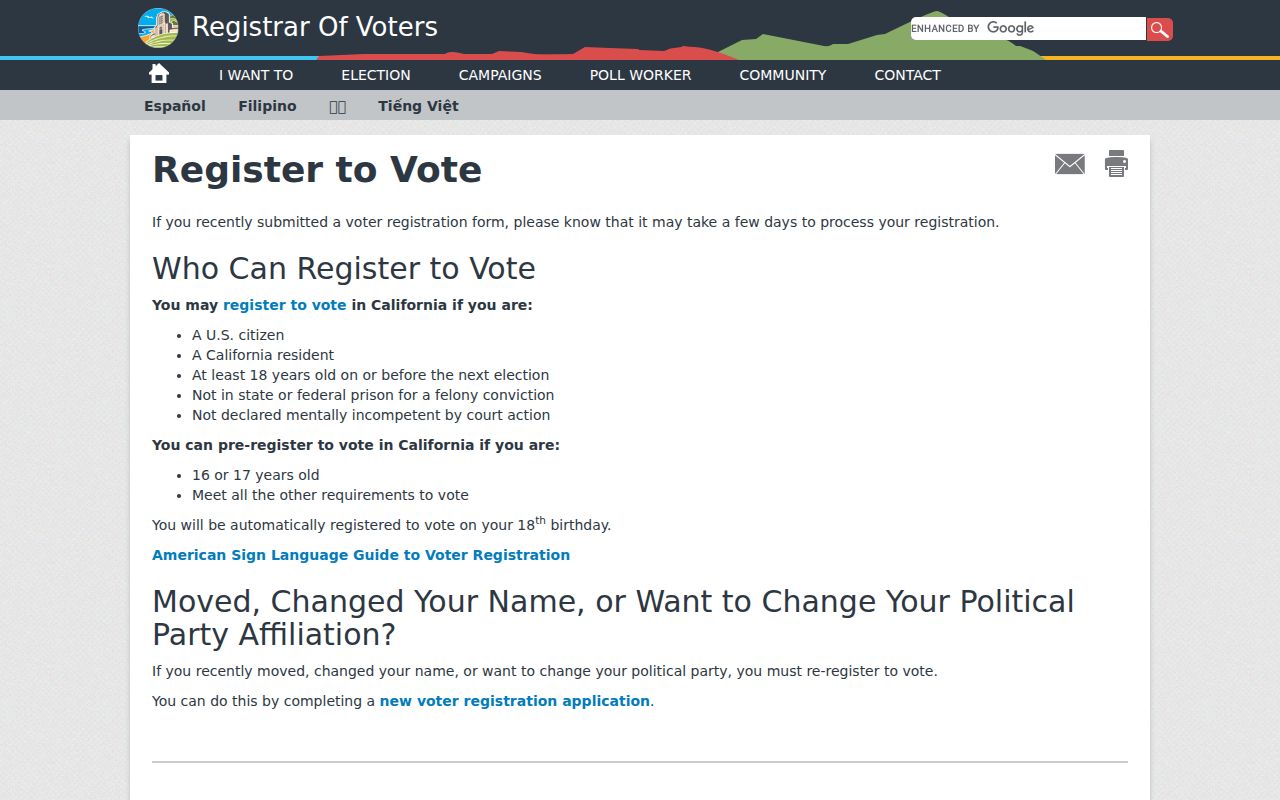
The San Diego voter registration page screenshot below illustrates its self-check role rather than a public roster.
Use the result as one time-stamped clue. It can support a person’s own records review, but it cannot fill the gaps left by renters, family members, protected voters, or people who are not registered.
| House number | Numeric residence component used for authentication. |
|---|---|
| Street name and type | Separate fields for the base road and suffix. |
| Birth date | Month, day, and year used with the address. |
| ZIP Code | Five-digit delivery geography supplied by the voter. |
When a San Diego Records Request Helps
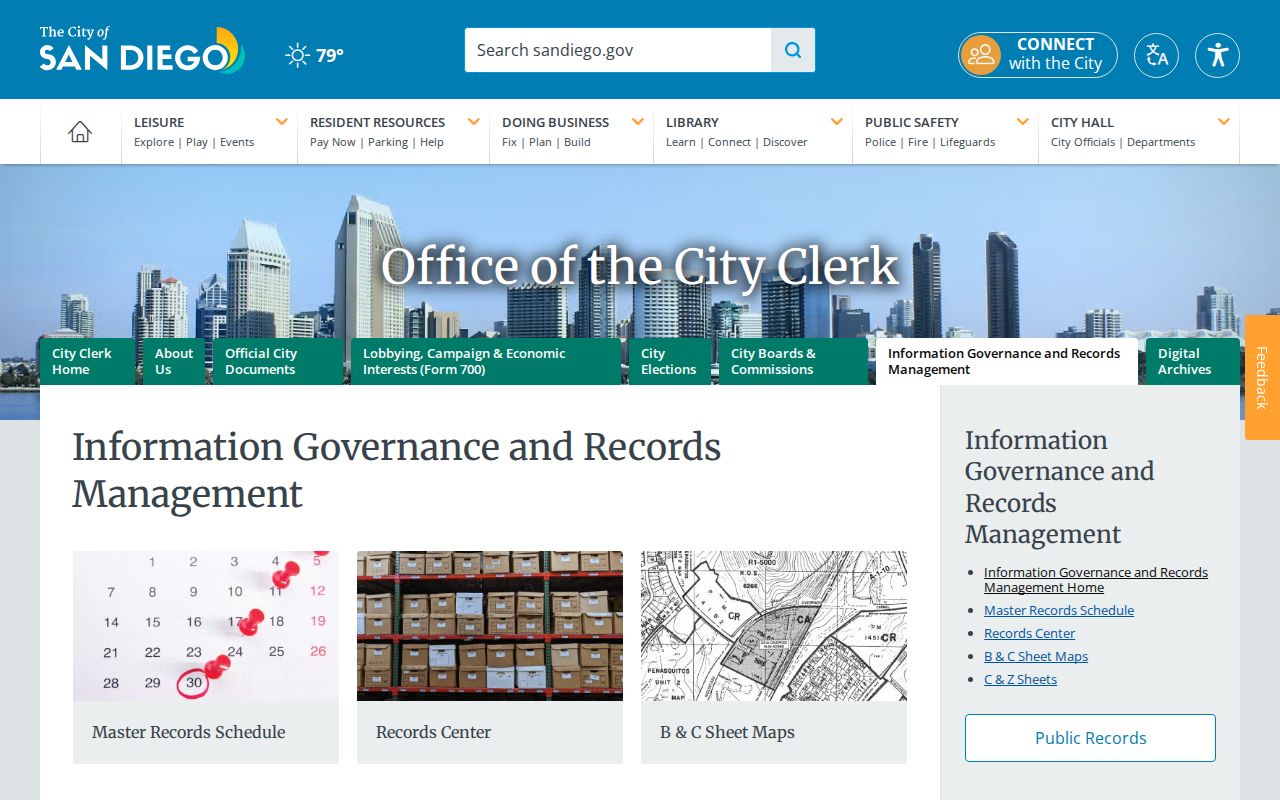
The City Clerk is San Diego’s municipal recordkeeper. Its Information Governance and Records Management division maintains a Master Records Schedule, operates a Records Center, handles public-record requests, and preserves historical city materials. The City Clerk Digital Archives at 202 C Street offers search help and recently added collections. The Records Center holds more than 42,000 boxes at 14 secure sites, which explains why a focused request can work when a web search does not.
Use the City Clerk records information and Digital Archives channels to name a department, address, project or case number, record type, and date range. Under the California Public Records Act, Government Code sections 7920.000 and following, an agency ordinarily makes a determination within ten days, with a possible fourteen-day extension for unusual circumstances. That is a determination period, not a promise that production will finish in ten days. The city does not have to create a new analysis or overcome a privacy exemption.
The City Clerk records page image below shows the municipal records route that supports a focused request.
For property records, Development Services supplies another channel: OpenDSD covers most permit and project data from 2003 forward, Accela holds several categories submitted after January 16, 2018, post-1955 files use a Records Review appointment, and pre-1955 building records route to the Assessor.
San Diego Historical Resident Directories
San Diego’s historical resident directories run from an early 1874 city and business directory to an onsite city-directory series advertised through 2021. The San Diego Public Library California Collection lists city directories from 1886-2021, while San Diego Yesterday links digitized volumes from 1887-1925. City Clerk scans include 1874, annual volumes from 1926-1943, combined 1944-45 and 1947-48, 1950, 1952, 1953-54, 1955 suburban, city and suburban volumes from 1956-58, and suburban volumes from 1959-60.
The annual entry usually provides a name, address, and occupation. Later volumes may show a spouse in parentheses, employer, residence marks such as `h` or `r`, and widow notation. A reverse or criss-cross section can turn an address into a list of people and businesses for that year. The San Diego Directory Book page carries the shelf, scan, and reading workflow in full. Here, the key point is that a directory is evidence of a printed snapshot, not a current resident roll.
San Diego Local History for Directories
The San Diego Public Library California Collection combines directories with the Great Register for 1888-1892, more than 800 maps and Sanborns, and San Diego Union material from 1868 onward. The genealogy collection holds more than 10,000 books and 1,000 periodical titles. Special Collections hours are Monday and Tuesday 11:30 a.m. to 8 p.m., Wednesday through Saturday 9:30 a.m. to 6 p.m., and closed Sunday. Ancestry Library Edition is an in-library resource, so remote searching does not always replace a visit.
Other channels matter. The San Diego History Center Research Archives, UC San Diego Special Collections, SDSU Special Collections, California State Archives, and City Clerk Digital Archives each have different finding aids and access limits. The Union obituary microfilm reaches back to 1865. City Clerk burial collections separate Mount Hope, IOOF, Masonic, Chinese Burial Index, County Burials, lot-owner books, and interment tickets. A name missing from one collection may still appear in another.
Note: Directory absence is negative evidence only after alphabetical, street, suburban, late-addition, spelling, and abbreviation sections have been checked.
San Diego Court Lookup Records
The San Diego Superior Court Index is a free locator for civil, criminal, family or domestic, mental-health, and probate cases. The usual online baseline is 1974 to the present. Central Division Older Records holds indexes from 1880 to mid-1974, with hardbound books for 1880-1964 and computer-generated indexes after 1964. Juvenile and traffic or minor-offense cases are excluded from the online index, and some older limited or misdemeanor entries have shorter availability.
A party search accepts case type, optional location, party type where applicable, beginning and ending filing years, last or business name, optional first name, and optional date of birth. A result can show case title, case number, file location, case type, filing date, and parties. It does not supply charges or disposition at the index level. The official file or Register of Actions is the next step, through online options where available, the courthouse counter, kiosks, or mail.
Copy access is separate from the locator. Court guidance describes $0.50-per-page copies, a search fee when a nonparty request takes more than ten minutes, possible certification and retrieval fees, and mail requests that include the case number, requested documents, contact details, envelope, and payment. A hard-copy request can take weeks. A court index hit should be described as a case placement until the underlying record is inspected.
San Diego Vital Records for Lookup
Birth, death, marriage, and divorce records use different custodians and access rules. San Diego County ARCC and the County Office of Vital Records and Statistics handle local certificates, while the California Department of Public Health handles statewide applications. Informational copies may be broadly available for some births, deaths, and public marriages. Authorized certified copies, which can establish identity, require an eligible requester and sworn statement. Confidential marriage records are limited to spouses, a court-order route, or a qualifying representative under Health and Safety Code sections 103526 and 103526.5 and Family Code section 509.
For a current 2026 comparison, the research records a $34 San Diego County birth copy and a $31 CDPH birth copy. County public-health services at 5530 Overland Avenue, Suite 170, use in-person and mail channels; in-person payment may be cash, card, tap, check, or money order, while mail uses check or money order. Regular mail is free, UPS is $19, and VitalChek adds $12.95 processing. CDPH forms, eligibility, and statewide fees remain a separate route. A historical index or obituary can suggest an event but is not a certified certificate.
- Birth
- Local source: County OVRS, ARCC, CDPH. Public clue: Event, date, place, family details. Certified access: Authorized requester with sworn statement.
- Death
- Local source: County, ARCC, CDPH. Public clue: Death event and possible kin link. Certified access: Rules vary by copy type.
- Public marriage
- Local source: ARCC or CDPH. Public clue: Names, date, public marriage record. Certified access: Authorized or informational copy.
- Divorce
- Local source: Superior Court, limited CDPH verification. Public clue: Case or verification clue. Certified access: Decree comes from the court.
San Diego Names in Two Records
A name match becomes stronger when it agrees with geography and time. Compare the APN or legal description, court location, business city, license dates, former address, occupation, spouse notation, or family connection. A registered agent is a statutory contact, not automatically a business owner. An assessed owner is not necessarily the resident. A court party is not necessarily the person who lives at a nearby parcel. A license address is an address of record, not proof of a dwelling.
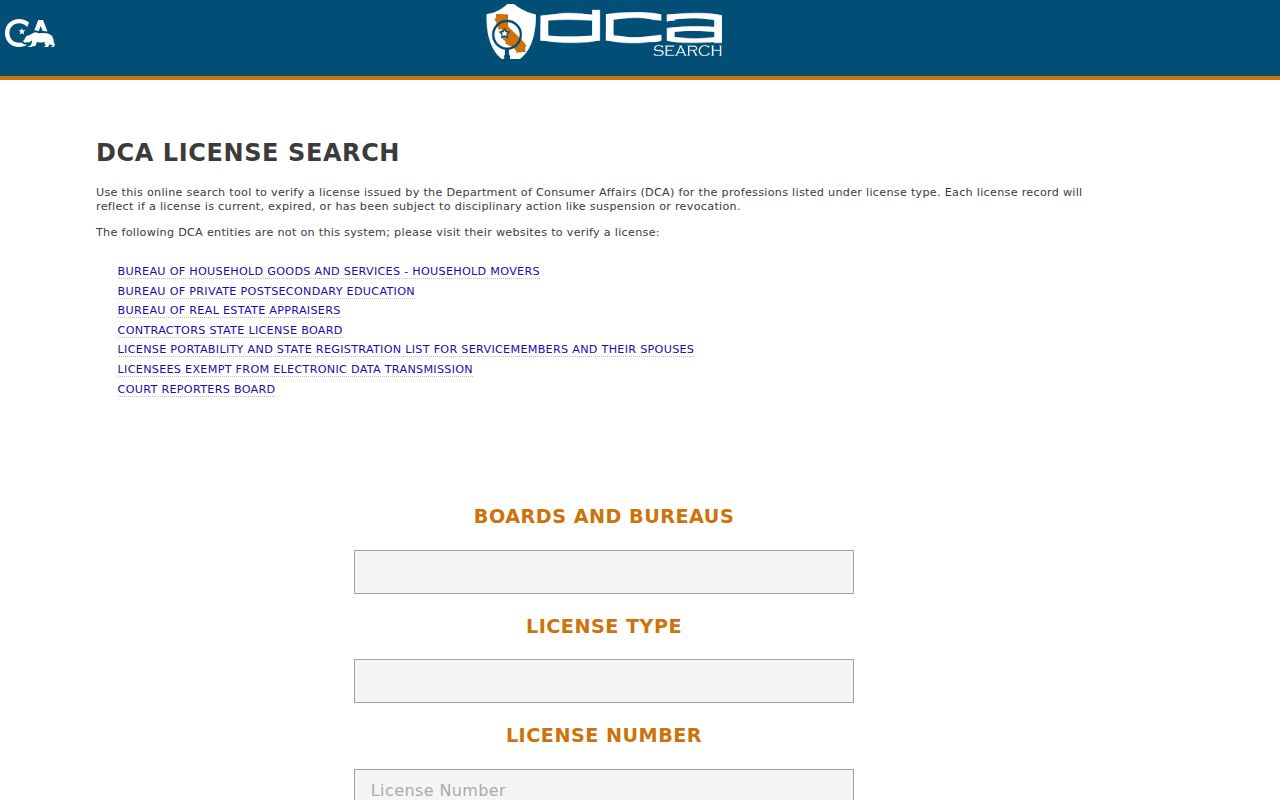
For a public role or professional affiliation, the California Department of Consumer Affairs license search can show board, license type, number, name, status, dates, address of record, and public discipline where the board displays it. The Secretary of State bizfile search can show entity name or file number, formation or registration date, status, jurisdiction, agent, street and mailing addresses, and filing history. Fictitious business names come from ARCC. Each result has to keep its role label.
The DCA license search screenshot below is a useful example of an official name search with a defined public scope.
For an entity clue, the bizfile business search screenshot shows a different record family and should not be read as a household list.
When two people share a name, preserve exact spelling, initials, former surnames, source dates, and record roles. If uncertainty remains, ask the custodian for a specific existing copy instead of asking an office to decide whether two people are the same.
Official Rolls and Commercial Compilations
Official records and commercial people-finder compilations serve different purposes. The official source is closer to the originating event and exposes its own limits. A commercial compilation may combine public and nonpublic data, merge people with similar names, lag a move or death, or recycle an old phone or address. It can be a lead for reconnecting with a relative or checking a possible scam, but it is not a substitute for the custodian’s record.
| Source type | Strength | What to verify |
|---|---|---|
| County or state record | Defined custodian, date, role, and access rule | Index versus image, eligibility, currentness |
| Library or archive collection | Time-specific names, addresses, and context | Publisher key, gaps, scan quality, onsite limits |
| Commercial compilation | May gather clues across many sources | Identity merge, stale data, lawful personal use |
Check the custodian. San Diego public records can be researched for lawful personal purposes, family history, civic understanding, and consumer safety. Do not use a name or address trail to stalk, harass, threaten, or harm anyone.
San Diego Privacy Changes in 2026
California’s new privacy tools affect downstream commercial data, not the public source record. The Delete Act and DROP portal let a California resident send one encrypted deletion or stop-sale request to more than 500 registered brokers. Requests began in 2026, and broker deletion duties began August 1, 2026. That process can remove or suppress covered commercial copies, but it does not erase a deed, court index, assessor record, or other government record held under a public duty.
For a source record, contact the custodian under the rule that applies. Voter, court, recorded-document, and license redactions use their own statutes and programs. The Secretary of State’s Safe at Home program offers a substitute mailing address, mail forwarding, and related protection for eligible participants, including qualifying victims and threatened public workers. It is prospective and does not guarantee that an old address disappears everywhere. A protected person should work with the program before making a record request or recording an instrument.
Note: A downstream opt-out and a government-record correction are different requests sent to different custodians.
San Diego’s Long Records Memory
San Diego County was created in 1850, but the county record trail reaches earlier through deeds, indexes, maps, and land descriptions. The County Archives preserves grantor and grantee indexes to 1846 and deeds to 1845. Before online search, a researcher worked through books, microfilm, shelves, counters, and finding aids. That older system still matters because the recorder web index begins in 1970 and the Superior Court online index begins in 1974.
San Diego’s preservation history also has its own story. In 1889, Mayor Gunn called for a fire-proof vault for City Clerk records. In 1959, the city considered a remote repository for vital city records in case of an atomic disaster. Later archival work, including a 1986 National Historical Publications and Records Commission grant, helped inventory large bodies of city material. Today’s Records Center uses more than 42,000 boxes across 14 sites, with conservation, microfilm, digitization, and a conversion lab for obsolete formats.
That history explains why the San Diego residents directory is a network of records rather than one database. Use the live portal when it reaches the needed year, then move to the kiosk, counter, mail route, library, archive, or court file that holds the missing layer. Search spelling variants in OCR scans, inspect the original page when possible, and record the date of every result.